Session 9 - Sanctification and Christian Ethics
Video
First Pause
Read Philippians 2:12-13, Galatians 5:16-26, Romans 6:1-4, 6:10-14, and Micah 6:6-8
“Sanctification is a progressive work of God and man that makes us more and more free from sin and like Christ in our actual lives”
- Wayne Grudem’s definition of Sanctification, Systematic Theology, p.648
- Does it worry or encourage you that we as believers play a part in our own sanctification?
- Is it encouraging to know that, in the end, our sanctification will be complete and we will be perfected? Does that knowledge affect how we live now?
- How can perfectionism, the extreme desire/need to be absolutely perfect, prove itself to be more of a hindrance than a help? Have you ever felt this in your life?
Insert these six words into the blanks below to create three complete sentences:
- Sanctification
- Salvation
- Presence
- Power
- Penalty
- Glorification
Being freed from the ____ of sin is ____!
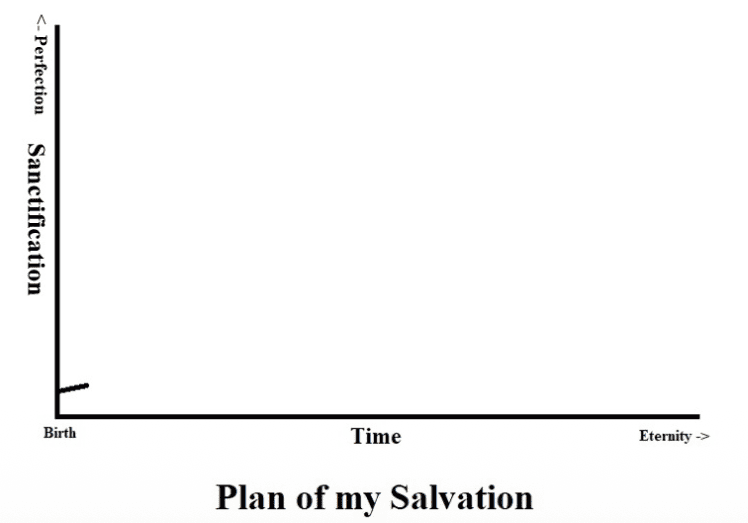
Fill in the graph below showing what your sanctification looks like:
Second Pause
Read Psalm 1, Proverbs 3:11, Hebrews 12:1-2, Romans 14:23
- Should the fact that all three members of the Trinity are actively involved in and causing our sanctification encourage us?
- What examples have you seen/experienced of the passive (shunning sin and relying on God) and/or active (striving to become better and more obedient) attitudes?
- How does being part of a group of believers help us in our Christian life, especially when it comes to trying to become more holy?
- Look over the lyrics of the hymn “Speak O Lord” and take notice of what God is asked to do, and what we as believers should do.
- 1) Speak, O Lord, as we come to You
- To receive the food of Your Holy Word.
- Take Your truth, plant it deep in us;
- Shape and fashion us in Your likeness,
- That the light of Christ might be seen today
- In our acts of love and our deeds of faith.
- Speak, O Lord, and fulfill in us
- All Your purposes for Your glory.
- 2) Teach us, Lord, full obedience,
- Holy reverence, true humility;
- Test our thoughts and our attitudes
- In the radiance of Your purity.
- Cause our faith to rise; cause our eyes to see
- Your majestic love and authority.
- Words of pow'r that can never fail—
- Let their truth prevail over unbelief
- 3) Speak, O Lord, and renew our minds;
- Help us grasp the heights of Your plans for us—
- Truths unchanged from the dawn of time
- That will echo down through eternity.
- And by grace we'll stand on Your promises,
- And by faith we'll walk as You walk with us.
- Speak, O Lord, till Your church is built
- And the earth is filled with Your glory.
Third Pause
Take a brief moment to list some Christian Ethics you know and, if you know one, note down a scripture to back this up.
Final Section
- Have you ever found it difficult to deal with other Christians who emphasise/display God’s commands in their lives differently to you? How should you react to these people?
- Consider passages like Jesus’ coronation speech (Luke 4:16-21/Isaiah 61), the ten commandments (Exodus 20:2-17/Deuteronomy 5:6-21), the Beatitudes (Matthew 5:3-12/Luke 6:20-23), and any other relevant passages that come to mind. What do you think of Gaius’ proposed order of importance? What are the implications of it?
| 1. Life and Death | 2. Family, Sex and Gender | 3. The Environment |
| 4. Justice | 5. Education | 6. Money |
- Will you answer Gaius’ challenge to dig deeper into the Bible’s view on these topics?